Brand Guidelines · v0.2

The brand is one
orange highlight.

"You don't know what you don't know.
Find out if you qualify."

"HIGHLIGHT" SYSTEM · EXTRACTED FROM CAPEXTAX.COM, ELEVATED · 2026-06-26
The idea

Warm ledger. One orange mark on the money nobody saw.

Capextax.com already owns a warm, editorial look — cream paper, charcoal serif headlines, a single orange accent. We keep that DNA and give the orange a job: it is the highlighter that marks the hidden money — the unclaimed allowance, the number on the invoice nobody circled. One orange mark per view. Everything else is calm, document-like, trustworthy.

That ties the brand straight to the campaign: you don't know what you don't know — here's the bit you missed.

Colour

Extracted palette, given roles

Lifted verbatim from the live site's CSS variables. Highlight Orange is precious — one orange thing per view. If everything's orange, nothing is highlighted.

Highlight Orange
#F4892F
The one accent — the highlighter on the hidden money. CTA, the chevron, the £ that matters.
Highlight Deep
#D4711A
Hover / pressed / underline shadow.
Ledger Ink
#1A1A1A
Primary text, wordmark on light.
True Black
#0D0D0D
Dark fields, video ink backgrounds.
Graphite
#6B7280
Secondary text, captions, the "Associates" grey.
Paper Cream
#F5F0EB
The default "document" surface.
Sage Mist
#F0F2ED
Alternate section background.
White
#FFFFFF
Cards, inputs, raised panels.
Functional
10B981 · F59E0B · EF4444
Success / warning / error — system states only.
Typography

Playfair, Inter, IBM Plex Mono

The signature move: a charcoal Playfair headline with one italic phrase and an orange highlight underneath. That's the visual hook on every key asset.

Display · Playfair Display · 600/700 + italic

Find unclaimed capital allowances.

Body · Inter · 400/500/600/700

Capital allowances are a statutory tax relief that lets a business deduct the cost of qualifying assets from its taxable profits. Clean, readable, the FT-explainer workhorse.

Label · IBM Plex Mono · 500/600 · uppercase, tracked

What's hidden inside · the gap · find out if you qualify

display-xlHidden in the walls
display-lgHidden in the walls
headlineHidden in the walls
subhead · Inter 600Hidden in the walls
body · Inter 400Hidden in the walls of every commercial property
label · Mono 600Hidden in the walls
The signature device

The highlight

A calm document with one element marked in orange — as if someone took a highlighter to the line on a tax return everyone else skimmed past. In motion, an orange highlighter sweeps across the key phrase and reveals it as the voice lands it. The reveal is the brand.

Most accountants never claim
capital allowances.
Voice & tone

Curiosity first. Accuracy always.

Open a loop ("that counts? I have that"), resolve with find out if you qualify. Technical-but-readable, FT-Explainer — plain, precise, a little dry, never hypey. Outcome and relief lead; the software is named second. It's a tax product, so every claim must be true.

"You don't know what you don't know.
Find out if you qualify."
THE CAMPAIGN SPINE — EVERY ASSET RESOLVES HERE

Accuracy guardrails — do not say

✗ "You overpaid tax" / "HMRC owes you a refund."  It's a relief / deduction on profits, not a refund.
✗ "The building itself qualifies."  Only the plant & machinery inside it (SBA is a separate, narrower relief).
✗ "It's only for new builds."  Second-hand commercial property qualifies too (pooling + S198).
✗ "You must own the property."  A tenant can claim their own fit-out spend — but not fit-out the landlord funded.
✗ "Integral features = embedded fixtures."  Integral features are a specific subset (6% special-rate pool).
Do / Don't

Keep it disciplined

✓ Do

  • Calm cream / ink surfaces, charcoal serif headlines
  • One orange highlight = the hidden money
  • Italic emphasis on the key phrase
  • Concrete £ numbers, real outcomes
  • FT-explainer calm and precision

✗ Don't

  • Fill the page with orange
  • Use orange as a generic "brand colour" everywhere
  • Make every word a headline
  • Round, vague or hypey claims
  • Salesy, exclamation-heavy, emoji-decorated copy
Social — examples

What the posts sound like

Three example LinkedIn posts, one per audience. Curiosity-gap hooks, accurate to the guardrails, soft awareness CTA. Drafted to run from Shane (personal) and the Capex Check company page.

Track A · Accountants
Capex CheckCapital allowances, made findable
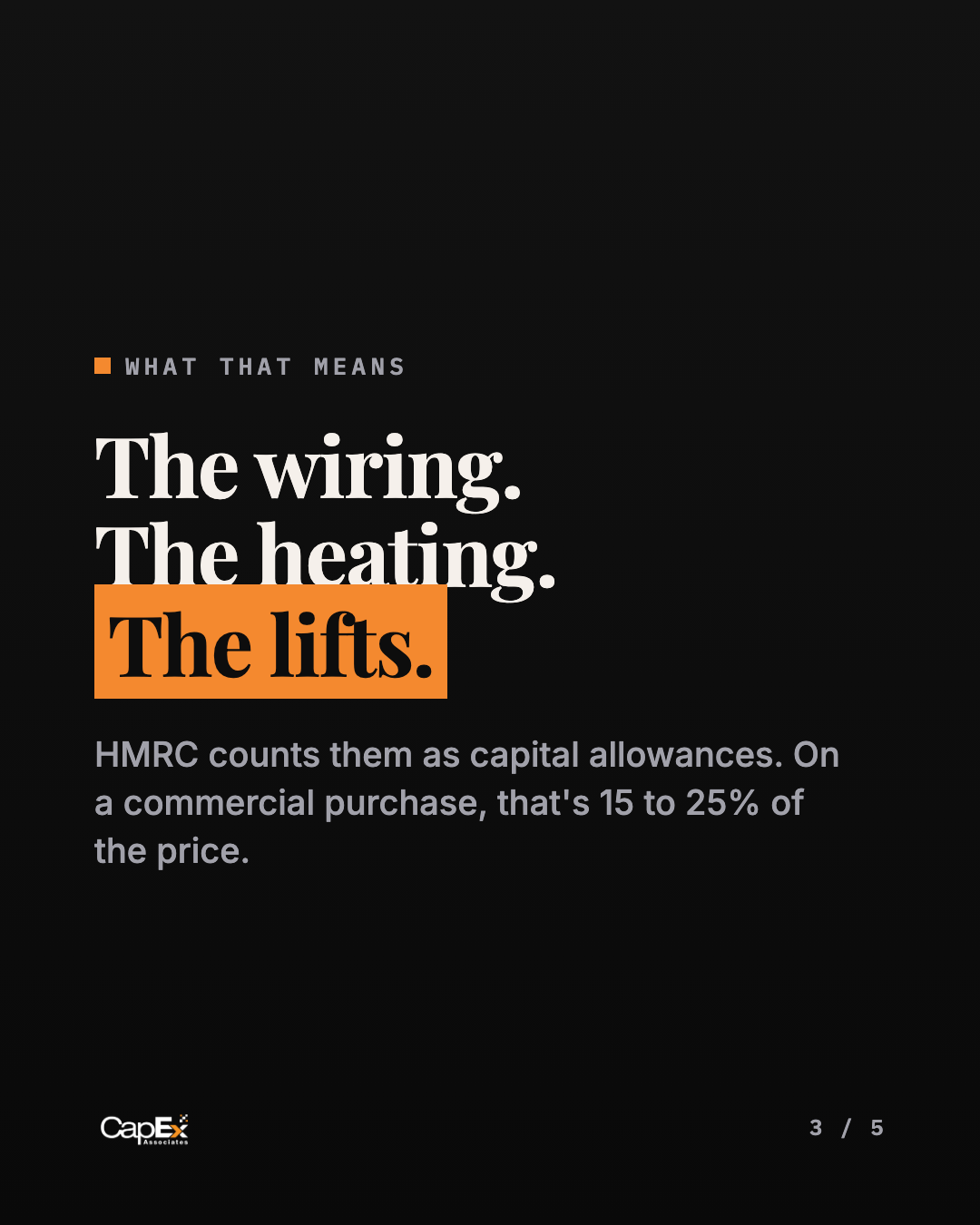
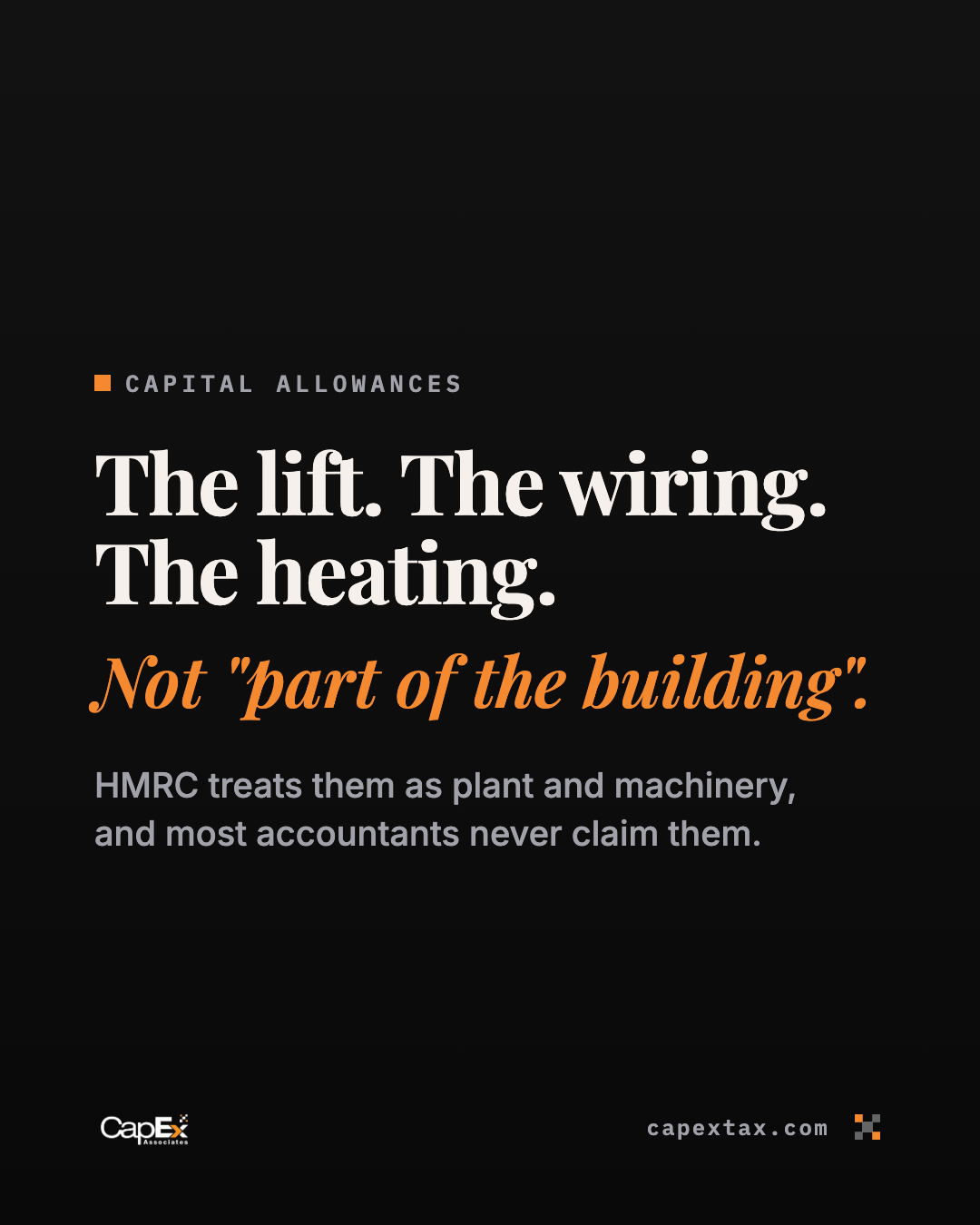
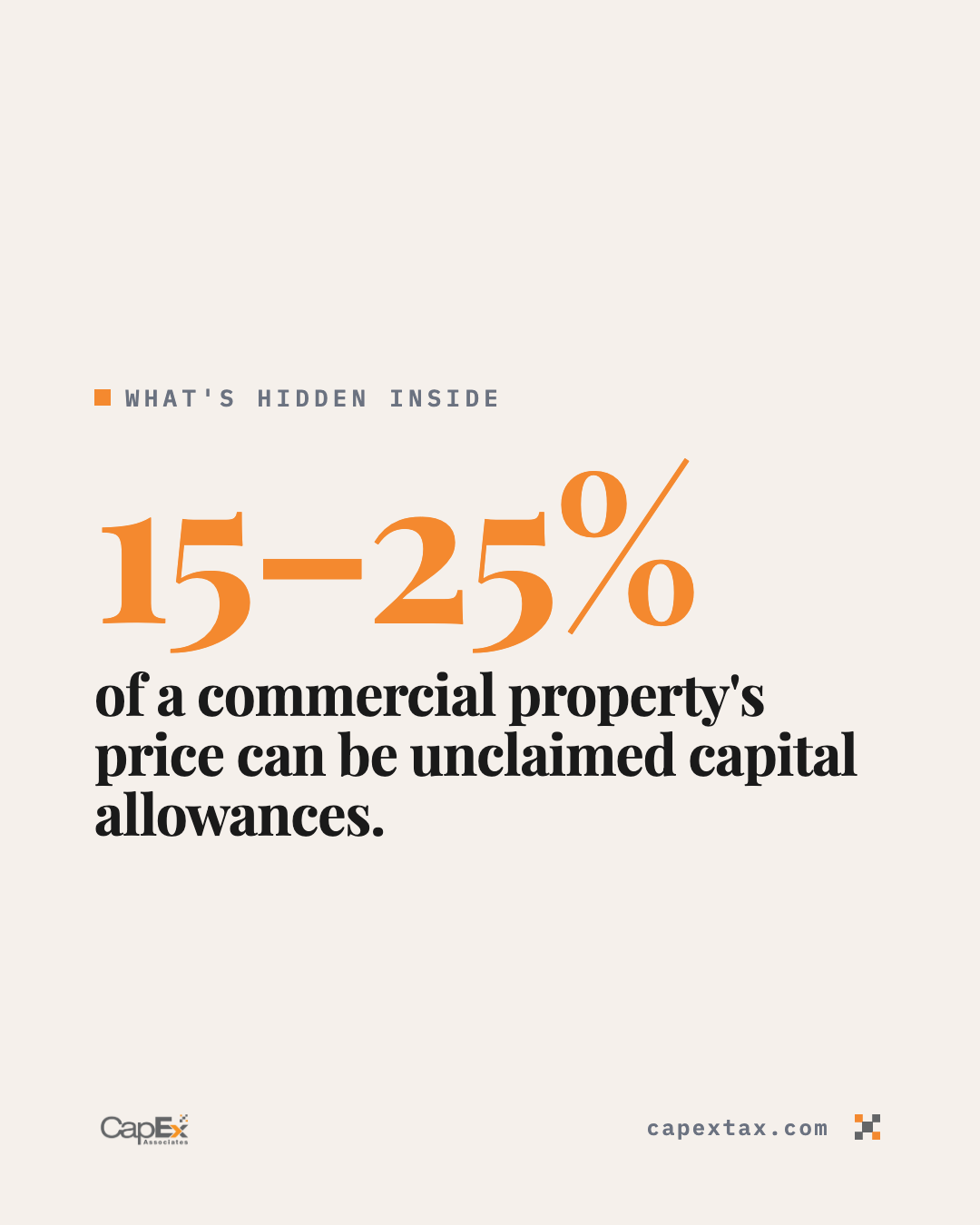
Most accountants think the lift is part of the building. HMRC doesn't. When a client buys commercial property, a big slice of the price isn't bricks and mortar. It's plant and machinery built into the building: the wiring, the heating, the air conditioning, the lift. On a typical commercial purchase that can be 15 to 25% of what they paid, and HMRC treats it as capital allowances. The catch is that standard accounts work never goes looking for it. So it sits there, unclaimed, year after year. You don't have to become a specialist to spot this. You just have to know it's there, and have a quick way to check. The accountants who look sharp in front of clients next year are the ones asking a question nobody else thought to ask.
↑ Like💬 Comment↻ Repost
Track B · Owners
Shane MocklerFounder, Capex Check
You didn't just buy a building. You bought the plant and machinery hidden inside it, and you've probably never claimed a penny of it. When you buy a commercial property, 15 to 25% of the price can be embedded fixtures: wiring, heating, air conditioning, lifts. HMRC counts those as capital allowances, which means tax relief you're entitled to. Most owners never claim it, because their accountant was never looking for it. Here's the part that surprises people. While you still own the property, there's no deadline. Spend from ten or fifteen years ago can still qualify. It's not money you overpaid. It's relief that has been sitting in your building, waiting for someone to find it. Two minutes is all it takes to find out if it's there.
↑ Like💬 Comment↻ Repost
Track B · Tenants
Shane MocklerFounder, Capex Check
"We rent, so capital allowances aren't for us." I hear this from business owners constantly, and it's quietly costing some of them a serious amount of tax. Capital allowances follow whoever paid for the work, not whoever owns the freehold. So if you lease your premises and you paid for the fit-out, the kitchen, the air conditioning, the partitioning, that spend can qualify for relief. The building can belong to your landlord and the allowances can still be yours. The one catch worth knowing: if your landlord funded part of the fit-out, that part is theirs to claim, not yours. Most tenants assume it only applies to people who own property. It doesn't. And nobody ever tells them. If you've spent money making a leased space work, it's worth two minutes to find out what qualifies.
↑ Like💬 Comment↻ Repost
Social — graphics

Single-image posts

Branded 4:5 graphics for the feed — a curiosity line, a stat, the spine. One orange highlight each, the real logo and data-cluster icon, on ink or cream.
Motion — examples

The video engine

A deterministic brand shell (hook → reveal → end card, British voiceover + ducked music + subject-driven b-roll) at clients/capex/brand/video/. Faceless, ~22s, the real logo, the highlight drawing on under the key line. One engine, two tracks. Both rendered 1:1 (below) and 9:16 vertical.

Track A · Accountants
"Your client also bought £400k of plant & machinery."
Free to identify, paid on execution. Keep the client, lose the work. Software, not service.
Track B · Owners & tenants
"Unclaimed relief sitting in a building you already own."
Relief follows whoever incurred the spend — owners, and tenants who fitted out leased premises. Not "overpaid tax".